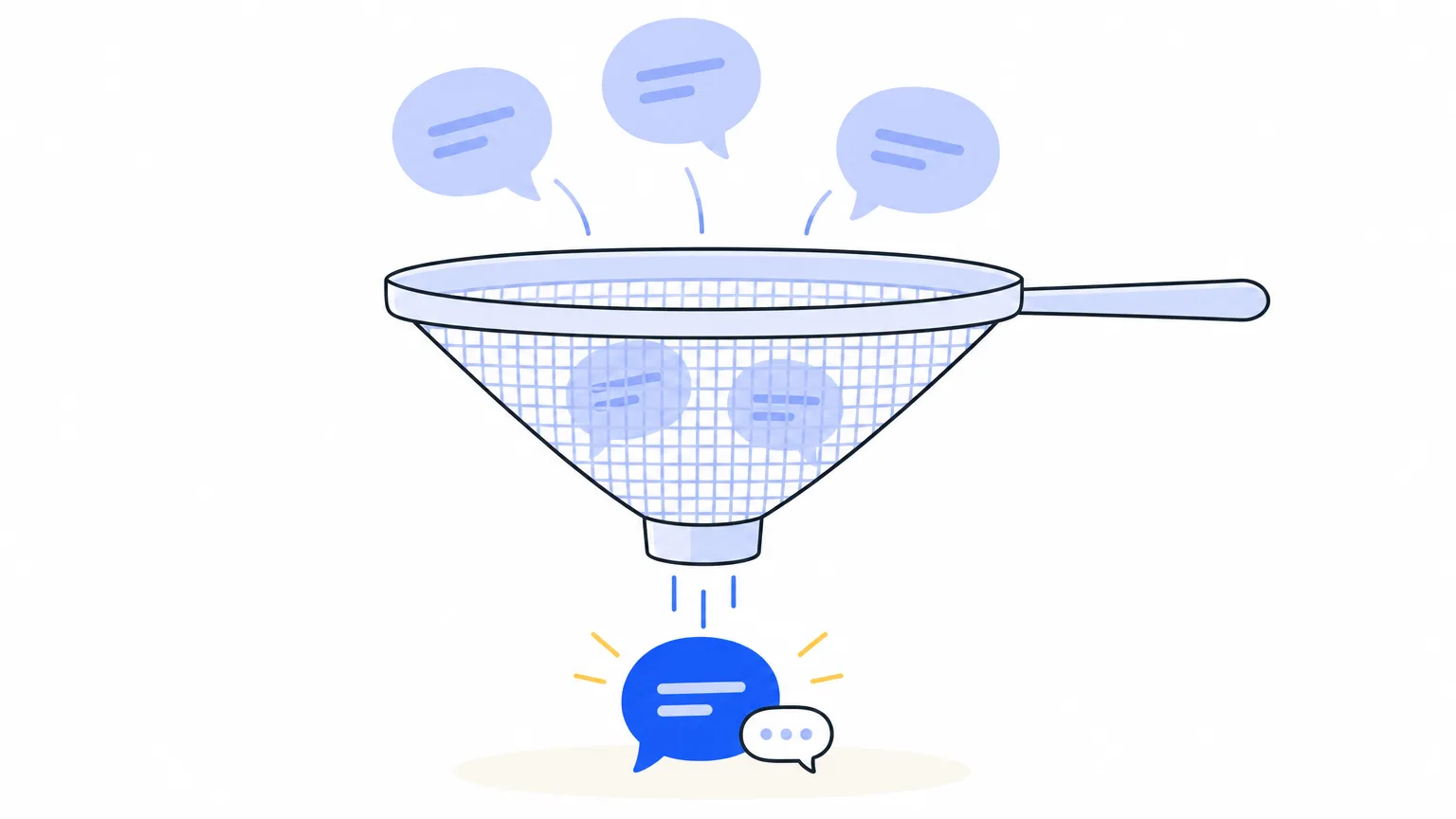
In Fin AI agent reporting, the "Fin" counter doesn't always say Fin answered. It says Fin was there. When an identification workflow (an email prompt, a form) runs before Fin gets to say a word, the conversation can still be counted as a Fin conversation. Here is the mechanics, what it skews, and how to check it. This isn't a critique of Intercom: it's a counting check.
What happens when a workflow runs before Fin?
A customer opens the Messenger. A workflow asks for their email address, sometimes a form. Fin is active on the conversation, but the customer hasn't asked anything usable yet, or an escalation rule sends the conversation to the team. Fin never had the chance to answer.
On the dashboard, that conversation can carry the Fin label. In the thread, there is no Fin answer to review.
Which API signal carries the information?
When an outside tool reads your conversations, it gets a boolean that says the AI agent participated, and a detailed object that only exists if Fin reached a resolution state. The public API reference lists the boolean without defining it any further: nothing says whether it means "Fin answered" or "Fin was active".
In Intercom's reports, the two notions do exist separately since the metrics revision: active (Fin took part, even if constrained) and involved (Fin had the chance to answer). A tool that reads only the participation boolean can't tell them apart from it alone. That is what we found on our side: without another signal, a conversation where only an identification workflow ran looks like a Fin conversation.
What does this counting inflate?
- Fin's share. The numerator counts conversations where Fin said nothing. Fin's share of volume looks higher than it is.
- Cost per conversation. A cost divided by too large a count of Fin conversations looks too low. Conversely, the resolution rate is pulled down mechanically, since workflows resolve nothing.
- Topic breakdown. Conversations without a question land in "handled by Fin" topics. Fin's topic ranking ends up distorted.
It's the same family of problem as containment rate: an activity count read as an outcome, much like the reopen rate people forget to check.
What did Intercom's metrics revision change?
Intercom published a revision of its Fin metrics on August 31, 2026. "Fin Constrained" conversations, where Fin was active without getting the chance to answer, no longer count in "Fin Involved". Reasons include a workflow triggered before Fin could respond, an escalation rule, a usage limit, an idle customer. Involvement rate goes down, resolution rate goes up, automation rate doesn't move, and neither does billing, according to the help page.
Two things to keep in mind. Standard reports follow the new definition, but existing custom reports keep the old one. And a resolution rate that rises because the denominator changed says nothing about the product. For a broader view, see how to score an AI agent's answers.
What did we do at ResponZ?
Since version 1.6.0 (September 20, 2026), the Fin cards on the Quality page are gone. The signal we received counted an identification form as a Fin answer: the cards were measuring something other than Fin's performance. We chose to remove them rather than show a wrong number, or add a disclaimer under a figure nobody reads.
The per-answer score only covers real Fin answers. That's what our Fin answer quality page is about.
Which three checks should you run on your own reports?
- Compare three counters. In an Intercom custom report, put side by side the conversations where Fin is active, those where Fin is involved and those where Fin is constrained. The gap between active and involved is the volume the broad counter inflates on your account.
- Break constraints down by reason. The Support Performance dashboard details constrained conversations, including "workflow triggered". Open twenty at random: how many have no Fin answer at all? That manual count is your own figure, dated and verifiable.
- Check each report's definition. A custom report built before the revision, an export or a third-party tool may still use the old one. Look for the "legacy" label and never compare two periods under two definitions.
Frequently asked questions
Is Fin billed on these conversations? According to Intercom's help page, the revision doesn't change billing. Check your own contract and invoice.
Is the automation rate wrong? According to Intercom, it doesn't change with the revision: it's computed on resolved conversations. The issue affects the share, the cost per conversation and the topics, not that figure.
What should I look at instead? The score of each Fin answer, on only the conversations where Fin answered. Net containment is a good start.